

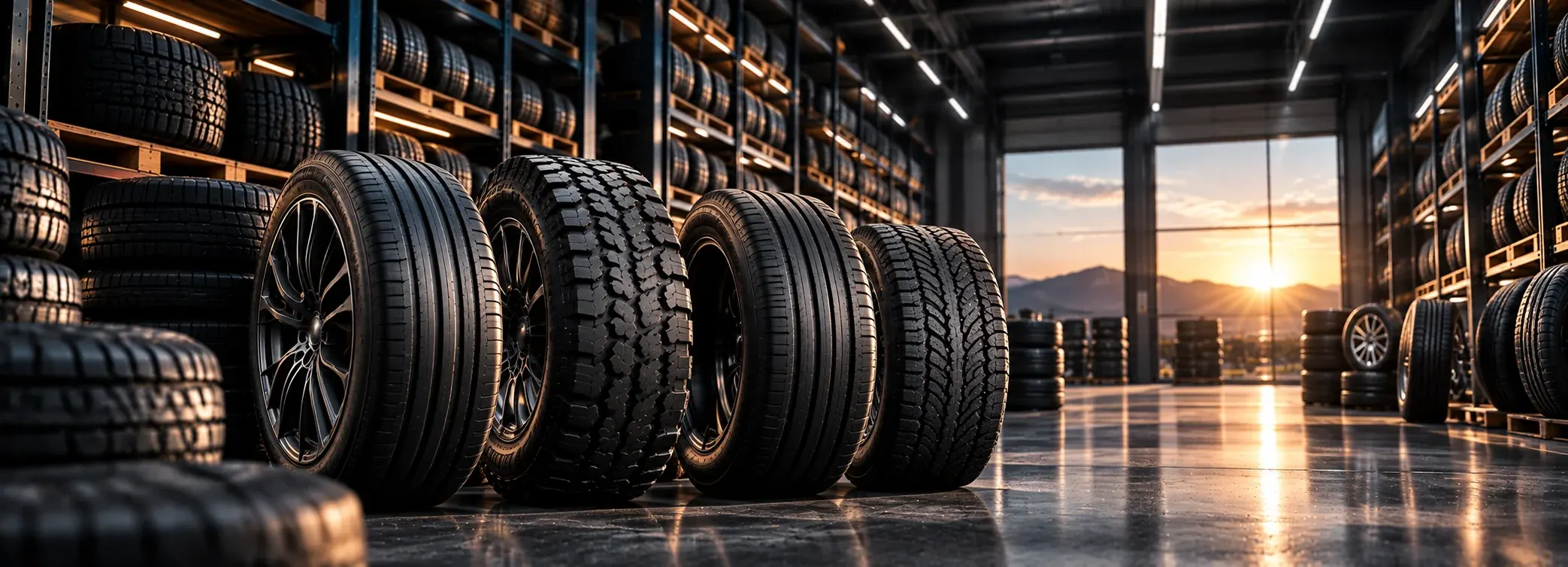
Tyres rarely fail suddenly: they almost always show in advance that it is time to replace them. It is important to spot these signs in time — a worn tyre brakes worse, punctures more often and can fail at speed.
1. Tread depth
The main and simplest criterion. You can measure the depth with a tread depth gauge at several points across the width of the tyre.
- Passenger car tyres: the wear limit is marked by TWI indicators — 1.6 mm high bars at the bottom of the grooves. On wet roads, grip drops noticeably at as little as 3 mm.
- Truck tyres: on the steer axle they are usually replaced earlier, with around 3–4 mm remaining, as it determines handling. On the drive and trailer axles, tyres can be used longer or sent for retreading.
- Forklift tyres: solid (super-elastic) tyres have an indicator line on the sidewall — when wear reaches it, the tyre is replaced.
2. Tyre age
The rubber compound ages even when not in use: it loses elasticity and becomes covered in cracks. This happens especially quickly in a hot climate and under direct sunlight.
- The production date is shown by four digits in an oval on the sidewall: for example, 2423 means the 24th week of 2023.
- Tyres older than 5 years should be inspected at least once a year.
- After 8–10 years, the tyre should be replaced even if the tread is still deep.
3. Visible damage
Immediate replacement is required when:
- a sidewall bulge — a swelling on the sidewall that indicates broken cord threads;
- a deep cut, especially on the sidewall;
- exposed cord — when the casing threads are visible;
- tread separation or deformation that makes the wheel wobble while driving.
4. Uneven wear
The wear pattern will tell you what is wrong with the vehicle. If the cause is not fixed, new tyres will wear out just as quickly.
- worn in the centre — pressure too high;
- both shoulders worn — pressure too low or the vehicle is overloaded;
- one edge worn — wheel alignment is out;
- patchy wear — wheel imbalance or problems with the suspension and brakes.
If it is time to replace your tyres, choose new ones in the SS TYRES catalogue or contact our specialists — we will help with the size and model.